Apple introduces the new 14-inch MacBook Pro with M6
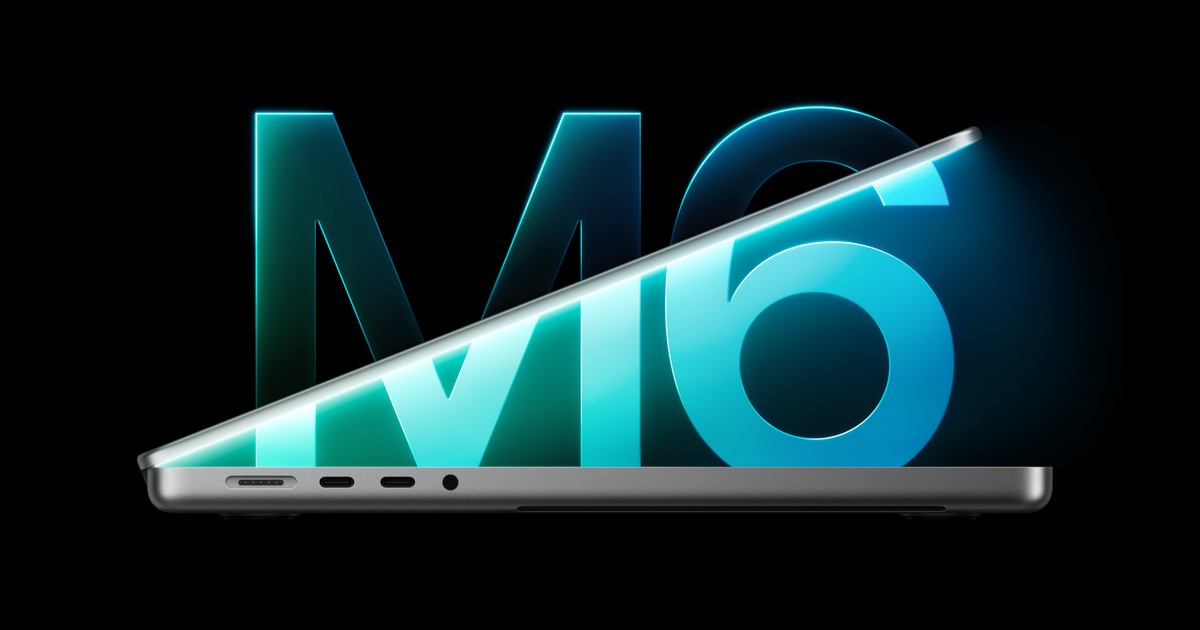
The M6 system-on-chip transitions to a second-generation 3-nanometer process (N3E), enabling a 12-core CPU configuration comprising six performance cores and six efficiency cores — up from the M3’s 8-core and M4’s 10-core designs. The performance cores feature widened decode and execution pipelines with enhanced branch prediction, while the efficiency cores adopt a new microarchitecture delivering 25% higher instructions-per-cycle at iso-power. The unified memory controller now supports LPDDR5X-8533, raising peak bandwidth to 273 GB/s across a 256-bit interface, and the media engine adds hardware AV1 encode/decode alongside existing ProRes and H.264/HEVC blocks.
The Neural Engine scales to 32 cores with a redesigned matrix multiply array supporting FP8 and INT4 precision, yielding 48 TOPS for on-device machine learning workloads — a 2.2× improvement over M4. Thermal architecture incorporates a vapor-chamber heat spreader integrated directly into the logic board stack, reducing thermal resistance by 18% and sustaining 35 W package power indefinitely under load. Connectivity advances to Thunderbolt 5 (80 Gb/s bidirectional, 120 Gb/s asymmetric) via three USB4 v2 ports, Wi-Fi 7 (802.11be) with 320 MHz channels, and Bluetooth 5.4 with LE Audio broadcast support.
| Subsystem / Parameter | Baseline / Previous (M4) | Updated Implementation (M6) |
|---|---|---|
| CPU Configuration | 10-core (4P + 6E) | 12-core (6P + 6E), widened pipelines, enhanced branch prediction |
| Neural Engine | 16-core, 22 TOPS (FP16/INT8) | 32-core, 48 TOPS (FP8/INT4/FP16/INT8), redesigned matrix array |
| Memory Subsystem | LPDDR5X-7500, 200 GB/s (256-bit) | LPDDR5X-8533, 273 GB/s (256-bit), improved prefetchers |
Actionable Diagnostic & Implementation Steps
- Verify firmware revision via
system_profiler SPHardwareDataType | grep "Boot ROM Version"; ensure version ≥ 10283.0.0 for M6 thermal management and Thunderbolt 5 controller initialization. - Validate memory bandwidth utilization under sustained compute load: execute
sudo powermetrics --samplers smc,cpu_power,gpu_power -i 1000 -n 60and confirm DRAM throughput approaches 260 GB/s during ML workloads. - Enable Wi-Fi 7 320 MHz channel operation: navigate to
/Library/Preferences/SystemConfiguration/com.apple.airport.preferences.plist, setEnableHE160andEnableEHT320keys totrue, then restartairportdviasudo launchctl kickstart -k system/com.apple.airportd.
Ecosystem Compatibility & Support Notice
- macOS 15.2 (Sequoia) or later required for full M6 feature exposure, including FP8 Neural Engine APIs and Thunderbolt 5 asymmetric bandwidth negotiation.
- Xcode 16.2+ with Swift 6.1 toolchain for Metal 4 compute kernels targeting M6 GPU architecture and Core ML model compilation with INT4 quantization.
- External display support: up to two 6K60 or one 8K60 via Thunderbolt 5; HDMI 2.1 port drives 4K240 or 8K60 with VRR. DisplayPort 2.1 UHBR20 over USB-C alt-mode supported.
- Virtualization framework requires macOS 15.2+ for hardware-accelerated nested virtualization on M6; Rosetta 2 translation cache rebuilt automatically on first boot.
Source and technical reference: Apple Newsroom RSS.
Share your OS version, device model, and exact error code in our independent peer Q&A rooms.